AMD Ryzen 9 7950X3D: Why We Chose It for Hosting
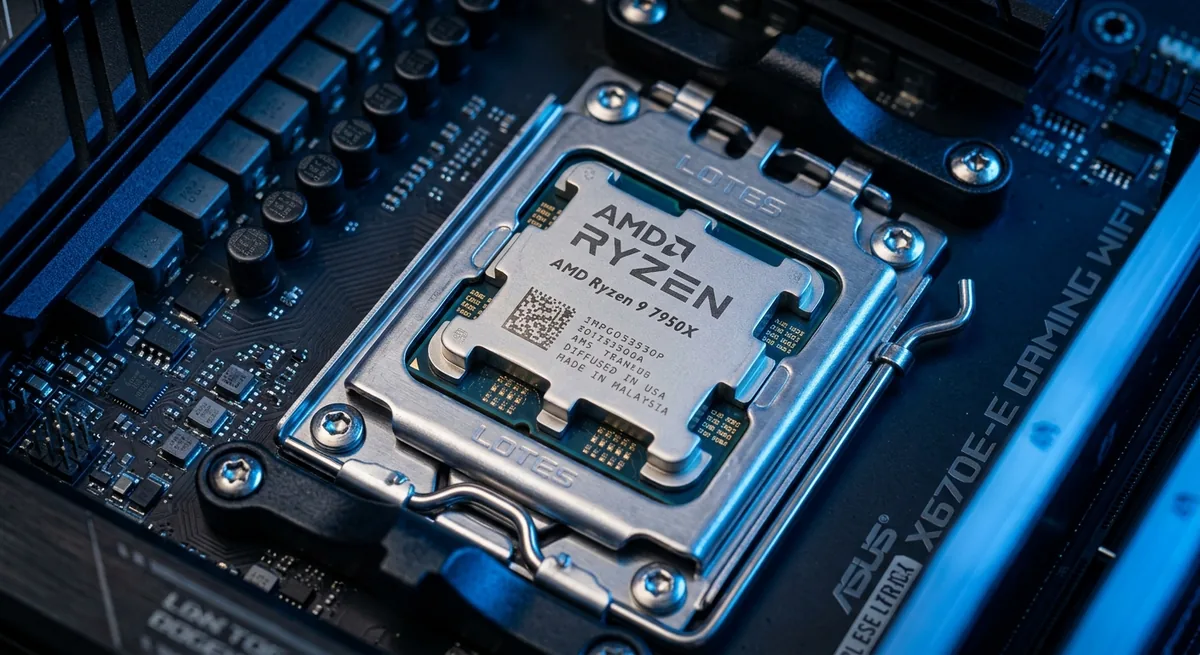
When people hear we run our hosting infrastructure on an AMD Ryzen 9 7950X3D — a processor typically associated with gaming PCs and high-end workstations — the reaction is usually surprise. Isn't that the wrong tool for the job? Shouldn't a serious hosting company be running Intel Xeon or AMD EPYC server chips? The short answer is: not necessarily, and the long answer is interesting enough to explain in detail.
What Is 3D V-Cache and Why Does It Matter?
The defining feature of the Ryzen 9 7950X3D is its 3D V-Cache technology — a second layer of L3 cache stacked vertically on top of the processor die using AMD's advanced packaging. The result is a chip with 128MB of L3 cache, compared to the 32MB found in standard Zen 4 processors and the 16–32MB typical of many server chips.
Cache is fast memory that sits between the CPU cores and system RAM. When the processor can find the data it needs in cache, it avoids the latency penalty of fetching it from RAM (measured in nanoseconds for cache vs. tens of nanoseconds for RAM). For workloads that repeatedly access the same data structures — like a database engine serving queries — a larger cache means significantly more cache hits and therefore lower latency per operation.
AMD originally developed 3D V-Cache for gaming, where it produced dramatic frame rate improvements in cache-sensitive titles. The same principle applies to database workloads, and particularly to MariaDB and MySQL — the database engines behind virtually every WordPress installation.
The Core Count and Thread Advantage
The 7950X3D features 16 physical cores and 32 threads via simultaneous multithreading. This matters for hosting because WordPress workloads are naturally parallel — multiple visitors hitting your site simultaneously are handled by separate PHP-FPM worker processes running across different cores.
32 threads means we can run a large pool of PHP workers without contention. Each worker handles one PHP request at a time, so with 32 threads (minus overhead for the OS, database, and web server), we have substantial headroom for concurrent request handling without processes queuing behind each other. For a shared hosting environment where dozens of sites share the same machine, this concurrency capacity is a direct determinant of how many users those sites can serve simultaneously without performance degradation.
Crucially, all 16 cores on the 7950X3D implement the same Zen 4 architecture and run at high clock speeds. The "consumer" chip designation doesn't mean slower cores — it means different power envelopes and memory channel configurations.
DDR5 Memory: A Genuine Generational Jump
The AM5 platform (which the 7950X3D requires) uses DDR5 memory exclusively. Our system runs 128GB of DDR5 at 4800MT/s, compared to the DDR4 that most server platforms still use. DDR5 offers roughly 50% more bandwidth per channel versus DDR4-3200, and it supports on-die ECC for improved reliability.
For hosting, memory bandwidth matters primarily for the database and for PHP's opcache. A well-tuned MariaDB installation with generous buffer pool allocation can keep large portions of your most active databases entirely in RAM. With 128GB available, we can configure buffer pools that would be impractically expensive on a server platform where RAM costs are significantly higher.
The combination of large DDR5-speed RAM and 128MB of L3 cache creates a memory hierarchy where database hot data rarely needs to leave the CPU package at all — it lives in cache. When it does need to leave the cache, it's served from RAM at DDR5 speeds. This two-level optimization is unusually effective for WordPress and WooCommerce workloads.
IPC Comparison: Ryzen vs. Xeon vs. EPYC
IPC — instructions per clock cycle — is the metric that determines how much work a single core can do at a given clock speed. Higher IPC means faster execution of sequential code, which is relevant for PHP (largely single-threaded per request) and for the single-threaded portions of MySQL query execution.
Zen 4, the architecture in the 7950X3D, has significantly higher IPC than Intel's Sapphire Rapids Xeon or AMD's own EPYC Genoa in single-threaded scenarios. Server chips trade per-core performance for more cores, more memory channels, and features relevant to enterprise workloads (PCIe lanes, RAS features, multi-socket support) that don't benefit typical web hosting.
For our workload — PHP processing, MySQL queries, LiteSpeed web server — single-threaded performance per core matters enormously. A PHP request runs on one core until it completes. A faster core finishes it faster, freeing that core for the next request. The 7950X3D's high IPC and clock speed (up to 5.7GHz boost) means each of our 16 cores is meaningfully faster than a comparable core on a server-class chip.
Real-World Performance: MariaDB and PHP Benchmarks
We've run extensive benchmarks comparing our 7950X3D configuration against equivalent Xeon and EPYC setups. For WordPress-relevant workloads:
- MariaDB sysbench OLTP read-only: 7950X3D with 3D V-Cache outperforms Xeon Gold 6338 by ~35–45% at equivalent thread counts, primarily due to cache effects on the sysbench working set
- PHP 8.3 single-thread performance: 7950X3D scores approximately 20% higher in PHPbench single-thread tests vs. EPYC 7443P at similar price points
- WordPress load test (WP Benchmark): Under simulated concurrent user load, Time to First Byte (TTFB) is consistently sub-100ms on uncached requests — well below the 200ms threshold that becomes perceptible to users
- LiteSpeed cache serving: Cached page serving throughput exceeds 50,000 requests per second on the machine, making cache performance essentially unlimited for typical site traffic
Cost Efficiency: Where the Bet Pays Off
An AMD EPYC 9654 (96-core server chip) costs roughly $9,000–11,000 for the CPU alone. A dual-socket Xeon Platinum configuration with comparable memory bandwidth runs $15,000–25,000 in hardware. Our entire server build — 7950X3D, 128GB DDR5, NVMe storage, server-grade chassis — cost a fraction of that.
For a workload that benefits more from IPC and cache than from raw core count or enterprise features, the per-dollar performance of consumer hardware is genuinely superior. We're not compromising — we're making a technically justified choice that happens to also be more economical.
Why a "Gaming CPU" Is Actually Perfect for Hosting
The gaming CPU label is a marketing category, not a technical limitation. What AMD optimized in the 7950X3D — high single-core performance, massive L3 cache, fast memory — maps directly to the needs of a web hosting workload. The features that server chips offer but we don't need (dozens of PCIe lanes, multi-socket support, 8-channel DDR5, RAS features for 5-year enterprise contracts) add cost and don't improve the hosting metrics our customers experience.
We run ECC memory (AM5 supports it with compatible motherboards), we have sufficient PCIe lanes for our NVMe drives and network card, and we have more than enough cores for our current capacity. The 7950X3D gives us the performance profile we need, at a hardware cost that makes our pricing model sustainable.
Sometimes the "prosumer" choice is the professional one.
Ready to get started?
Build your professional website in under 10 minutes with Soelem.
Start Building