Why We Colocate Instead of Rent
When most people start a hosting company, the playbook is predictable: sign up for a Hetzner account, spin up some cloud VMs, slap your brand on top, and call it a hosting business. It's fast, it's flexible, and the upfront cost is almost nothing. We considered that route. Then we did the math.
The Standard Model: Renting Someone Else's Hardware
Cloud VPS reselling is how the majority of small hosting companies operate. You're essentially a middleman — buying compute from a datacenter or cloud provider at bulk rates, then selling it to your customers at retail. The margin looks good on paper, often 40–70%, and you never have to worry about hardware failures, data center contracts, or physical infrastructure.
But there's a fundamental problem with this model: you are permanently at the mercy of your provider. If Hetzner raises prices (and they have), your margins shrink overnight. If AWS announces an infrastructure fee change, you either eat the cost or pass it on to customers. You have no control over the underlying hardware, no ability to optimize at the metal level, and you're building a business on top of someone else's foundation.
For a company that wants to compete on performance and price transparency, renting was never going to work.
The Cost Math: $375/Month vs. $20,000+
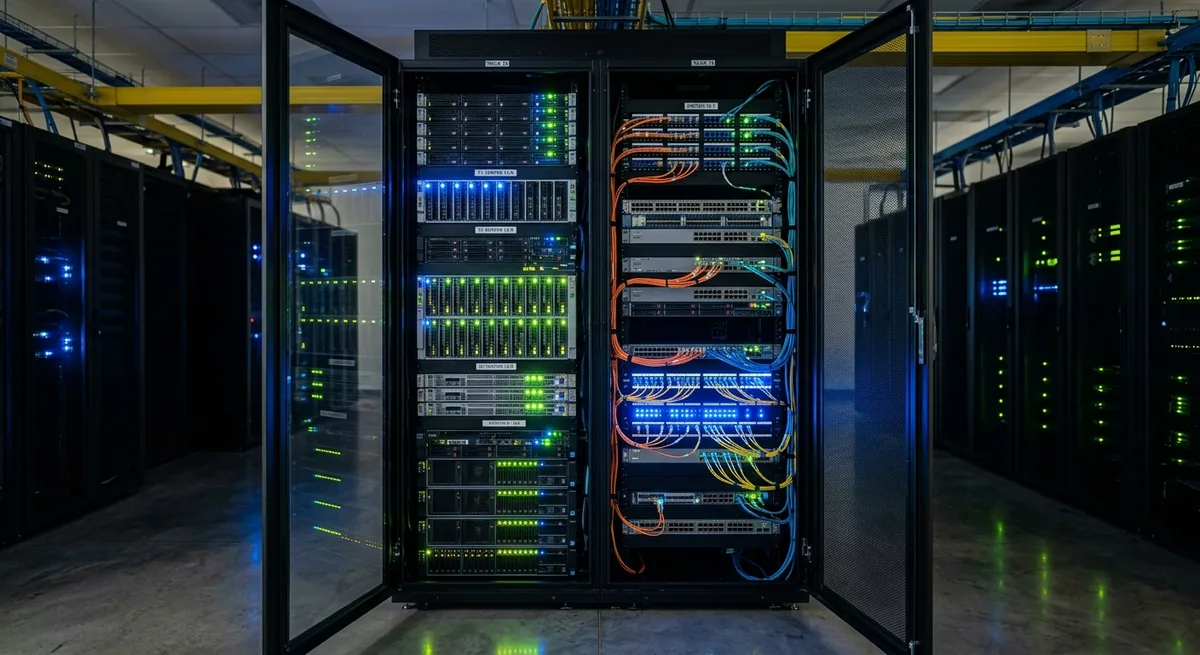
Let's get concrete. Our primary production server is a dedicated machine colocated at Hetzner's Falkenstein facility in Germany. We own the hardware outright — an AMD Ryzen 9 7950X3D with 128GB of DDR5 RAM and multiple NVMe SSDs. The colocation fee (rack space, power, bandwidth) runs us approximately €350–375 per month.
What would equivalent capacity cost us if we rented it?
- A comparable dedicated server rental from Hetzner: ~€350–500/month (if available, often waitlisted)
- Equivalent compute on AWS EC2 (c7a.8xlarge, 32 vCPU): ~$1,800–2,200/month
- Google Cloud equivalent: ~$1,500–2,000/month
- Azure: ~$1,900–2,400/month
At hyperscaler pricing, we'd be spending $20,000+ per year for infrastructure that we own for a one-time hardware purchase plus ~$4,500/year in colocation fees. The hardware pays for itself in under 18 months. After that, our infrastructure cost is just the colo fee — while renting customers pay forever.
Hetzner Falkenstein: Why This Facility
We didn't just pick any colocation facility. Hetzner's Falkenstein campus is one of Europe's most efficient data centers, operating with a Power Usage Effectiveness (PUE) of around 1.1 — meaning nearly all electricity goes directly to compute, not cooling overhead. The facility is powered significantly by renewable energy, gives us excellent network peering across Europe, and has a track record of reliability that most boutique colos can't match.
Falkenstein also gives us something critical: low latency to our core customer base in Central and Eastern Europe. If you're running a business in Romania, Poland, the Czech Republic, or Germany, your website is physically close to this facility. That matters for performance in ways that shared cloud regions often can't match.
Performance Control: The Hidden Advantage
When you own the hardware, you control everything about how it performs. We can tune the Linux kernel parameters specifically for our workload. We can configure the BIOS for maximum single-core performance (critical for PHP and WordPress). We can choose exactly how many PHP-FPM workers to allocate per account, how aggressive the OPcache settings are, and how MariaDB buffer pools are sized.
On a shared cloud VM, you get a hypervisor-mediated slice of a machine that's also running dozens of other tenants' workloads. "Noisy neighbor" problems are real — another customer's process spikes CPU, and your latency suffers. With dedicated, colocated hardware, that problem disappears entirely. Our customers' sites don't compete with strangers for resources.
Why Most Hosts Rent (And Why It Makes Sense for Them)
To be fair, the rental model isn't stupid — it's rational for most hosting businesses. Hardware ownership requires capital. Our server hardware cost several thousand euros upfront. For a bootstrap operation with limited runway, that's a significant bet. Cloud VMs let you start with almost nothing and scale as revenue grows.
Hardware also requires operational expertise. If a drive fails at 3am, someone has to coordinate with the datacenter for a replacement. That's complexity most early-stage companies prefer to avoid. Cloud providers handle all of that for you.
We were willing to absorb those challenges because we believe the long-term economics are superior, and because we wanted to build something that couldn't be undercut by a simple price change from our upstream provider.
Price Lock Economics: Ownership Enables Predictability
One of our core customer promises is price lock — your renewal price is the same as your signup price, forever. We can make that promise because our primary infrastructure cost is fixed. The colocation fee doesn't change based on how many customers we have. The hardware is already purchased. As we grow, our per-customer infrastructure cost actually decreases.
A hosting company renting cloud VMs can't honestly make that promise. If their provider raises prices, the economics force a choice between absorbing the loss or passing it to customers. We've removed that variable from the equation.
The Bet on Ownership
Owning hardware in a professional colocation facility isn't the path of least resistance. It requires more capital, more operational complexity, and more planning. But it gives us something no amount of cloud flexibility can replicate: a cost structure that improves as we scale, performance characteristics we control completely, and the ability to make long-term pricing commitments to our customers.
For us, colocation isn't just an infrastructure choice. It's a statement about what kind of hosting company we want to be.
Ready to get started?
Build your professional website in under 10 minutes with Soelem.
Start Building